Malay
- English
- Español
- Português
- русский
- Français
- 日本語
- Deutsch
- tiếng Việt
- Italiano
- Nederlands
- ภาษาไทย
- Polski
- 한국어
- Svenska
- magyar
- Malay
- বাংলা ভাষার
- Dansk
- Suomi
- العربية
- हिन्दी
- Pilipino
- Türkçe
- Gaeilge
- Indonesia
- Norsk
- تمل
- český
- ελληνικά
- український
- Javanese
- فارسی
- தமிழ்
- తెలుగు
- नेपाली
- Burmese
- български
- ລາວ
- Latine
- Қазақша
- Euskal
- Azərbaycan
- Slovenský jazyk
- Македонски
- Lietuvos
- Eesti Keel
- Română
- Slovenski
- मराठी
- Srpski језик

Berita
Curtain Wall Renovation: How to Avoid Pitfalls with Transparent LED Displays?
When renovating curtain walls in commercial buildings, many projects opt for transparent LED displays, which combine advertising with natural lighting and have become a popular solution for shopping malls, office buildings, and commercial complexes. However, many contractors focus solely on transparency specifications during procurement, overlooking practical issues such as curtain wall structure, heat dissipation, and long-term maintenance. As a result, problems such as reduced natural light, water ingress into the screens, difficulties in disassembly and repair, and brightness levels unsuitable for outdoor environments often arise after completion, leading to increased rework costs. When undertaking a transparent LED display retrofit for a curtain wall, these key points must be considered in advance.
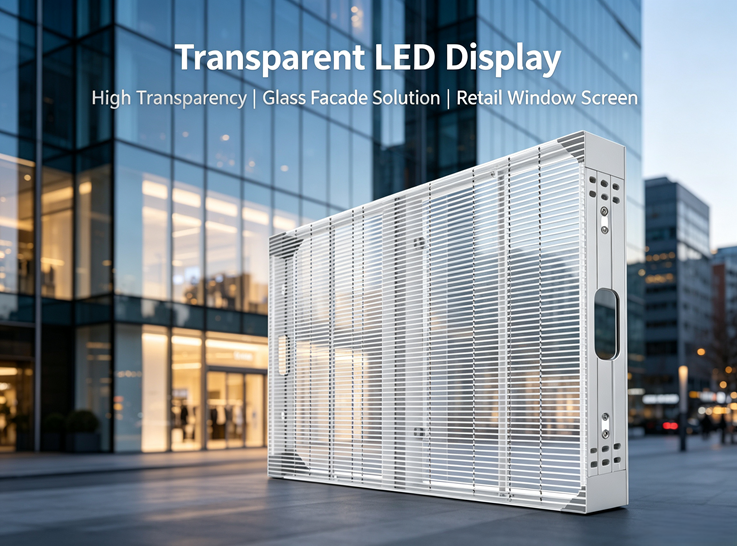
First, it is important to understand that light transmittance does not equate to actual performance. Many manufacturers advertise high transmittance specifications, but these are often idealized laboratory data. The higher the transparency rate, the sparser the LED arrangement, which can result in a decline in image quality. Curtain wall retrofits must be balanced with the building’s natural lighting requirements. For office building curtain walls, priority should be given to ensuring adequate indoor lighting; for shopping mall curtain walls facing the street, display quality can be appropriately considered—but do not blindly pursue extreme transparency at the expense of blurry images.
Second, adapting to the existing curtain wall structure is key to a successful retrofit. When retrofitting existing curtain walls, it is not possible to pre-reserve installation spaces as in new construction projects. It is essential to verify the glass load-bearing capacity and the dimensions of the support framework. Although Transparent LED Displays are lightweight and slim, they still require reliable mounting. Never force installation, as this can create potential load-bearing hazards for the existing curtain wall. For outdoor curtain wall applications, waterproof sealing design must not be overlooked; if joints and wiring points are not properly sealed, rainwater infiltration can damage the LED panels and shorten the screen’s service life.
Brightness selection must be tailored to the usage environment. Outdoor curtain walls are exposed to direct sunlight during the day; if brightness is insufficient, the image will appear washed out and illegible. For indoor storefront screens, excessive brightness can cause glare and disrupt the indoor environment. Transparent LED Displays installed on exterior-facing curtain walls require high-brightness outdoor specifications, while those in indoor storefronts facing the street can use medium brightness to avoid wasting energy.
It is also important to prioritize ease of maintenance. Curtain wall installations involve working at heights, making repairs difficult and costly. Prioritize Transparent LED Displays that support single-point module repair, eliminating the need to remove entire panels. Power supplies and control systems should be positioned in locations that facilitate maintenance to minimize the need for high-altitude disassembly and modifications. Confirm the heat dissipation solution in advance; the enclosed environment of a curtain wall makes it difficult for heat to escape, and poor heat dissipation can accelerate LED chip degradation, leading to screen distortion and dark spots.
Finally, do not overlook regulatory compliance. Curtain wall retrofits constitute modifications to a building’s exterior facade; some structures require filing and approval. Confirm relevant requirements before construction to avoid the project failing inspection upon completion.
In summary, a properly selected Transparent LED Display can maximize the commercial value of the curtain wall while balancing architectural aesthetics, natural lighting, and advertising display effectiveness. For curtain wall retrofit projects, Allenson offers a grid-style Transparent LED Display, which feature a lightweight design and low wind load, are compatible with existing curtain wall frames, and boast an IP67 protection rating to withstand outdoor weather conditions. They support front maintenance, making high-altitude inspections more convenient. Additionally, we offer customized solutions for brightness and transparency based on the curtain wall’s natural lighting and on-site conditions, providing a one-stop solution to address various challenges in renovating old curtain walls and ensuring the project’s successful implementation.
Berita Berkaitan
- Apa yang Menjadikan Pembersih Mangkuk Tandas Antibakteria Penting untuk Bilik Mandi yang Bersih?
- Apa yang Menjadikan Skrin Paparan Sewaan P6 Pilihan Tepat untuk Acara Besar?
- Bagaimana Modul Paparan LED Pandangan Halus p2 Boleh Mengubah Pengalaman Visual Dalaman dengan Kualiti Imej Sangat Jelas
- Dalaman atau Luaran: Bagaimana untuk Memilih Paparan LED Sewaan?
- Memasang Skrin Besar pada Dinding Tirai Kaca? Mengapa Ramai Memilih Paparan LED Lutsinar?
- Mengapa Pilih Skrin LED Lutsinar Dahulu untuk Pengiklanan di Dinding Tirai Kaca Pusat Beli-belah?
Tinggalkan saya mesej